
Breast Augmentation

Breast augmentation is a surgical procedure designed to increase breast volume and improve breast shape and proportion. It may be performed for patients who desire larger breasts, have experienced changes in breast volume after pregnancy or weight loss, or have differences in breast size or development.
Considerations
Consultation includes assessment of breast size and shape, chest wall anatomy, skin quality, nipple position and asymmetry, as well as discussion of implant placement and expected outcomes. Patients should understand that implants are not lifetime devices and may require additional surgery in the future.
Procedure
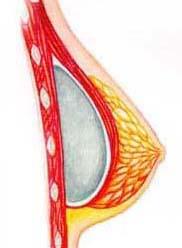
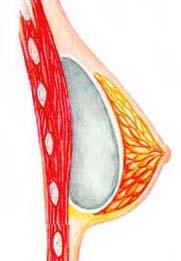
Augmentation is most commonly performed using silicone or saline implants, which may be placed either beneath the breast tissue or partially beneath the pectoral muscle. Implant selection is individualized based on the patient’s anatomy, chest dimensions, existing breast volume, skin quality, desired size and shape, and lifestyle. Implant width, projection, volume, and profile are all important considerations—not simply the number of cc’s.
For patients with significant breast drooping (ptosis), an implant alone may not provide the desired result. A breast lift (mastopexy) may be performed at the same time to reposition the nipple and reshape the breast. In some patients, fat grafting can be used in combination with implants to refine breast contour and cleavage.
Placement of the implants and incision location
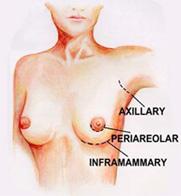
Breast implants can be placed either under the chest muscle, or between the chest muscle and the overlying breast tissue. Each choice has advantages and disadvantages. The same goes for the choice of the possible incision location through which to place the implant.
Your plastic surgeon will discuss implant placement location and location of the incision with you.
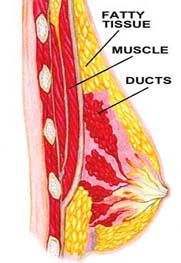 |
 |
 |
 |
Types of implants
There are two types of breast implants available in Canada. The first type are saline implants. These devices have a silicone elastomer rubber shell and are filled with saline solution (salt water). Advantages of saline implants are that they can be inserted through a smaller incision, they may cost less and they will be easily apparent if they leak or deflate. Some surgeons feel that saline implants provide a less natural look and feel than silicone gel implants.
The second type of implant is called a cohesive silicone gel implant. These are made with the same silicone shell but they are filled with a cohesive silicone gel. Advantages are that they often feel softer and more natural than saline implants, however they do require a slightly larger incision and may be more difficult to detect if they break or rupture.
Your plastic surgeon will discuss the type of implants available to you.
Potential Complications
Potential complications include infection, bleeding, changes in nipple or breast sensation, asymmetry, capsular contracture, implant rupture or leakage, implant malposition, and the need for revision surgery. Rarely, breast implant–associated anaplastic large cell lymphoma (BIA-ALCL) and other implant-associated conditions can occur. Appropriate patient selection, informed consent, and long-term follow-up are important components of safe breast augmentation.
Goals
The goal of breast augmentation is not simply to make the breasts larger, but to create proportion, symmetry and a natural-looking result that is appropriate for each patient’s anatomy and goals.
Breast cancer risks
All women have a risk of breast cancer and you will need to consider this prior to making a decision about whether or not to have implants. Breast implants do not increase the risk of developing breast cancer however they can make it more difficult to perform and read mammograms. Your plastic surgeon will discuss cancer detection with you.
Please click here for information from the American Food and Drug Administration (FDA) on ALCL (Anaplastic Large Cell Lymphoma) and breast implants.